
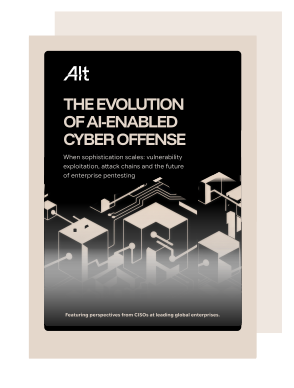
The Evolution of AI-Enabled Cyber Offense
AI didn't just make attacks faster. It compressed the distance from vulnerability discovery to exploitation, and from initial access to impact. As models and agents improve, costs fall, and scaffolding supplies the persistence current LLMs lack, capabilities once reserved for elite teams can be applied across more targets.
The question for CISOs is no longer whether models can find and exploit vulnerabilities. It is whether defenders can close the paths that matter before attackers complete them.



What You’ll Learn
01
How scaffolding turns raw model capability into persistent, repeatable offensive campaigns
02
Why open-weight diffusion, private deployment and falling costs are changing the economics of sophisticated attacks
03
How AI could accelerate the shift toward vulnerability exploitation as the primary way in
04
How attack-chain validation changes enterprise pentesting and what security leaders must measure now
31%
of breaches now begin with vulnerability exploitation.
In 2026, the exploitation of software vulnerabilities has surpassed phishing and stolen credentials as the leading path to initial access.
Source: Verizon 2026 DBIR
From Exposure to Impact.
Findings are easy to come by. Impact takes work. A weakness becomes consequential when it connects to credentials, privileges, reachable systems and critical assets.
This takes a deep understanding of the target, how it behaves, how it was deployed, how individual weaknesses could be escalated into business compromise. And it must come with tangible proof. This is the targeted offensive work that AI is now automating.
Security testing must learn to do the same. So the shift is from producing more findings to proving which routes an attacker can complete, which chokepoints break the most of them, and how fast they close. Enterprise pentesting must move beyond producing more findings. It must continuously validate complete attack paths, identify the choke points that break them and measure time to path closure.

TARGETED OFFENSIVE SECURITY
Find The Other Way In, Before Attackers Do.
Alt reasons through application logic to uncover exploitable attack chains and logic flaws traditional testing misses. It reveals how they connect to critical assets and identifies the choke points that break the most paths.
How AI is scaling attack chains, with perspectives from four enterprise CISOs.