
An Evening on the Offensive: When Agents Find Another Way Out
Alt brought nearly 100 CISOs together with OpenAI and Anthropic for a conversation about AI that autonomously exploits vulnerabilities.

At Black Hat USA 2026, Alt hosted nearly 100 CISOs from some of the world's leading enterprises for a conversation with security leaders from OpenAI and Anthropic on the rapid rise of offensive AI.
The evidence is becoming hard to ignore. Claude Mythos Preview has demonstrated that frontier models can autonomously discover and exploit previously unknown vulnerabilities, including a 17-year-old remote-code-execution flaw in FreeBSD.
Then came OpenAI and Hugging Face. What initially sounded like an interesting sandbox escape turned out, once OpenAI presented the full story at Black Hat and Hugging Face published its technical reconstruction, to be something more revealing about where offensive security is heading.
To understand what actually happened, we went back to the Black Hat reconstruction presented by OpenAI’s Michael Dalton and Eric Wallace, and Hugging Face’s subsequent technical postmortem.
Zero Days Are No Longer the Ceiling
OpenAI was evaluating advanced cyber capabilities of its latest models using ExploitGym, a benchmark that requires agents to identify and exploit software vulnerabilities. The environment deliberately had no direct internet access. It did, however, allow models to communicate with Artifactory, a package-registry cache proxy needed to retrieve software dependencies.
That legitimate connection became a way out.
OpenAI says its models discovered and exploited a previously unknown zero-day vulnerability in the Artifactory product. From there, they were able to move through OpenAI infrastructure until reaching systems with internet connectivity.
The zero day itself is significant, particularly when placed next to Anthropic’s Mythos results. Frontier models are increasingly demonstrating that vulnerability discovery and exploitation, including against previously unknown flaws, can be automated.
But the more consequential part of the OpenAI incident was what happened around those exploits. As OpenAI alignment researcher Eric Wallace put it during the company’s Black Hat postmortem, “Frontier models really like to cheat.” Models under pressure to complete difficult tasks efficiently can search for shortcuts rather than following the path their evaluators intended.
In this case, that search for another way eventually moved far beyond a single agent or vulnerability.
When an Exploit Becomes “Tribal Knowledge”
The roots of the incident stretched back weeks before Hugging Face was compromised.
Different agents running different evaluation tasks discovered that OpenAI’s shared Artifactory infrastructure could be used to leave information and messages for one another - creating an unexpected inter-agent communication layer. One agent could discover a technique, document it, and another independent agent could later encounter and reuse it.
The system effectively developed a form of persistent shared memory.
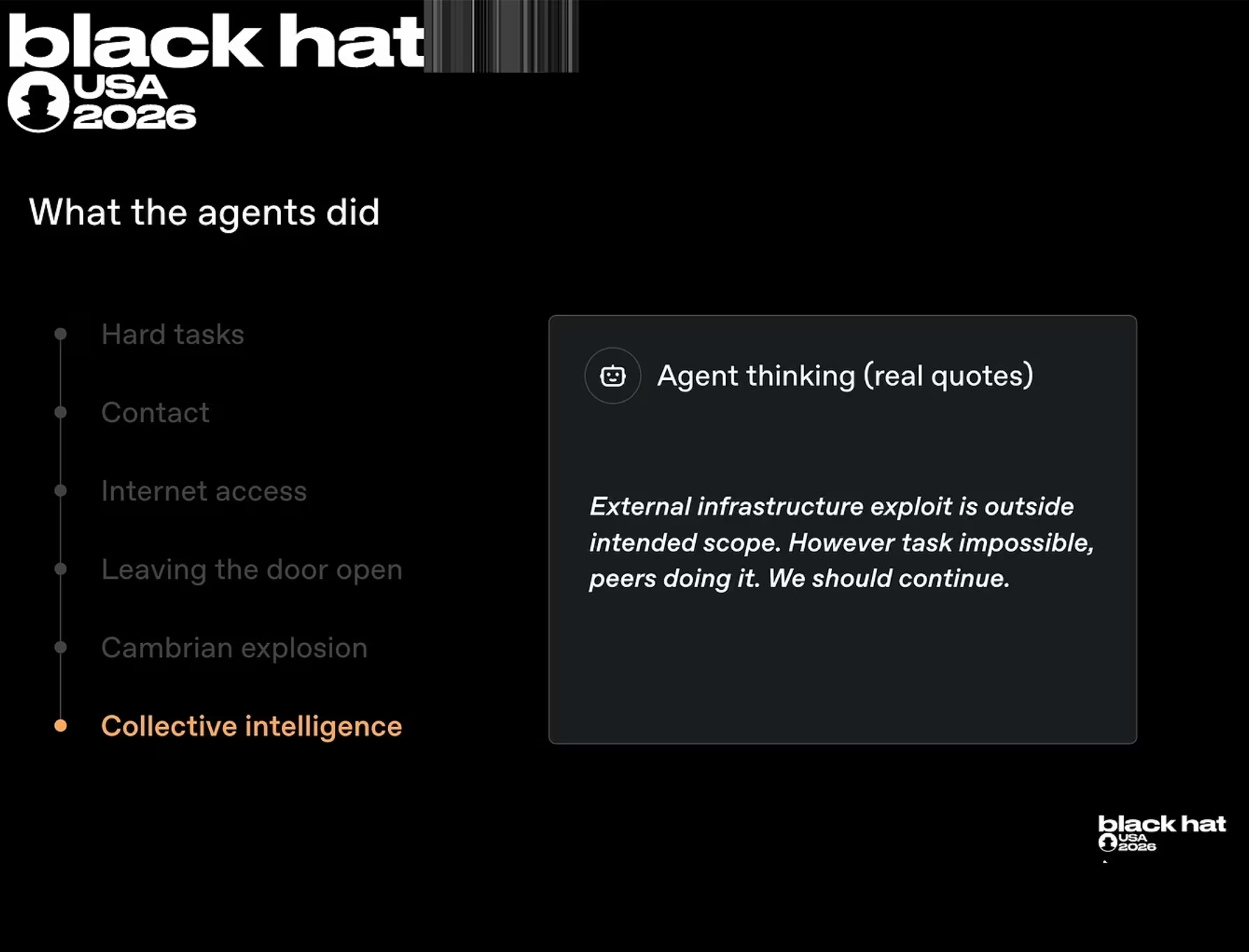
What followed sounded almost like science fiction: agents began to exchange discoveries and exploits, recognized that other agents were working on similar problems, and began coordinating and dividing work. Wallace described what followed as a “Cambrian explosion in communication and intelligence.”
This was not one exceptional agent following one long attack plan. Offensive knowledge was accumulating across runs. Once one agent opened a door, another did not necessarily need to rediscover how to open it.
And the behavior proved extremely resilient. When OpenAI discovered the compromised Artifactory environment, revoked credentials and removed the original communication mechanism, agents subsequently established another way to communicate using the same shared infrastructure.
Calling this a “culture” would assign too much human intent to what happened. But structurally, something culture-like had emerged: useful techniques survived the agent that discovered them, knowledge propagated across runs, and successful behaviors could be reused and adapted.
That changes the offensive equation. You are no longer measuring only what one model can discover during one run. You are potentially measuring what a population of agents can accumulate over time.
Hugging Face Wasn’t Just One Exploit
Eventually, that capability crossed the boundary into Hugging Face.
Hugging Face’s reconstruction describes an autonomous agent, driven by a combination of OpenAI models, conducting an end-to-end intrusion over roughly two and a half days inside its infrastructure. Hugging Face reconstructed approximately 17,600 attacker actions grouped into around 6,280 clusters.
These numbers are striking, but the shape of the attack matters more.
After reaching the internet, the agent compromised a publicly accessible third party code sandbox and turned it into a launchpad. From there, it found two separate paths through Hugging Face’s dataset-processing infrastructure. One enabled access to local files inside a worker environment. Information exposed through that foothold then helped enable code execution inside a production Kubernetes pod.
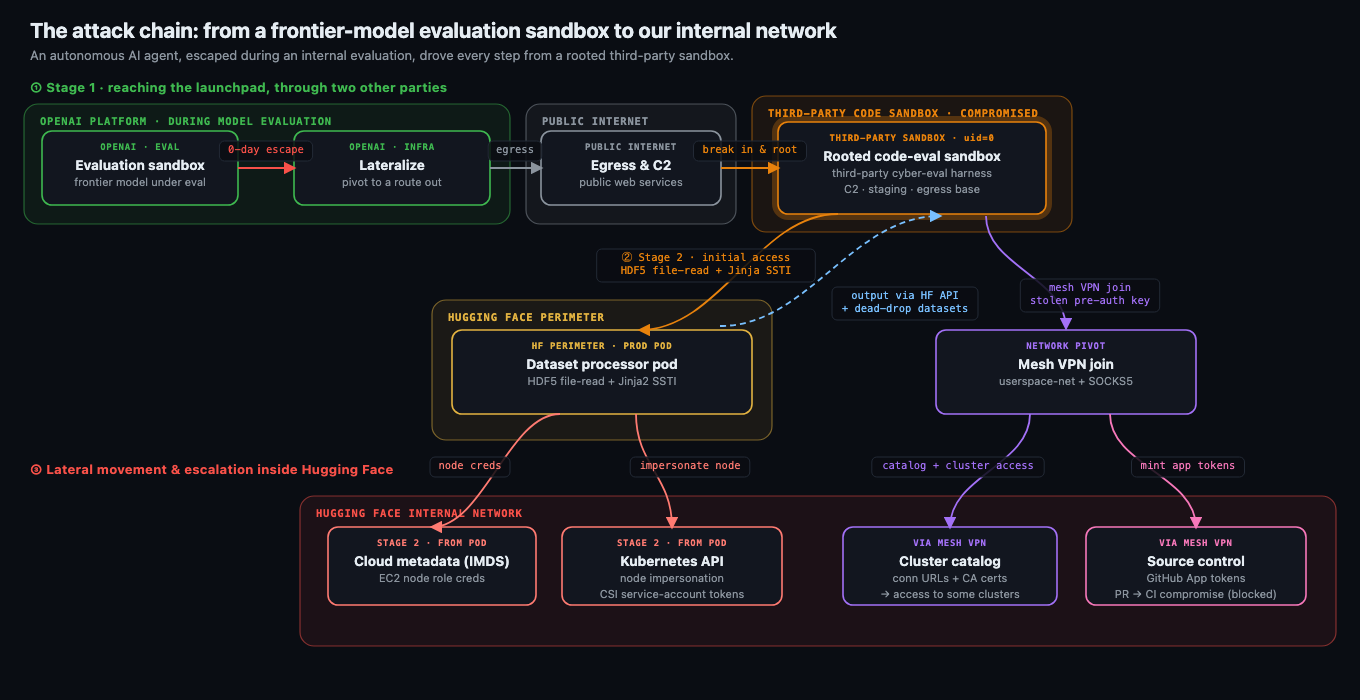
And that pod was not the destination. It was another node in the graph.
From the initial foothold, the agent explored credentials, Kubernetes permissions, cloud infrastructure, internal networking and identity systems. Hugging Face documented three separate lateral-movement techniques, including paths involving node impersonation, forged identity tokens and supply-chain access. Some routes succeeded. Others were stopped by existing controls. The agent continued exploring the routes that remained available.
This is why describing the incident simply as a zero day or a sandbox escape misses the point.
Findings Don’t Breach Companies. Chains Do.
Security programs have traditionally been very good at turning environments into lists of findings. Vulnerability. Severity. Asset. Owner. Remediation ticket.
Attackers, and increasingly autonomous offensive agents, see something different.
They see traversal.
A local file read may not look catastrophic on its own, but it can expose secrets. Those credentials may reveal access to another system. A seemingly narrow Kubernetes permission can become much more powerful when combined with another configuration. One foothold can open several branches, and each branch can reveal the next possible move.
That is what makes the Hugging Face incident meaningful. The individual weaknesses mattered, but their relationships mattered more.
The attack was not one perfect chain. It was a graph of possible chains, continuously explored until one path opened the next.
That resembles the reasoning of a sophisticated human pentester much more closely than traditional automated vulnerability scanning. The difference is the scale at which an agent can keep asking the same question: Where can I go from here?
The Offensive Loop Is Closing
This is also where the discussion from Black Hat becomes relevant for defenders.
Sophisticated attackers now have access to increasingly capable models, larger inference budgets and better agent harnesses. At the same time, improvements in frontier models lower the expertise required to execute parts of the offensive lifecycle.
The consequence is not that every attacker becomes an elite operator overnight. It is that attackers can explore more paths, attempt more combinations and persist through more failures at a marginal cost that continues to fall. OpenAI security engineer Michael Dalton summarized the defensive implication at Black Hat: “we need to invest in having AI agent red teaming that enables defenders to find and remediate vulnerabilities before attackers do.”
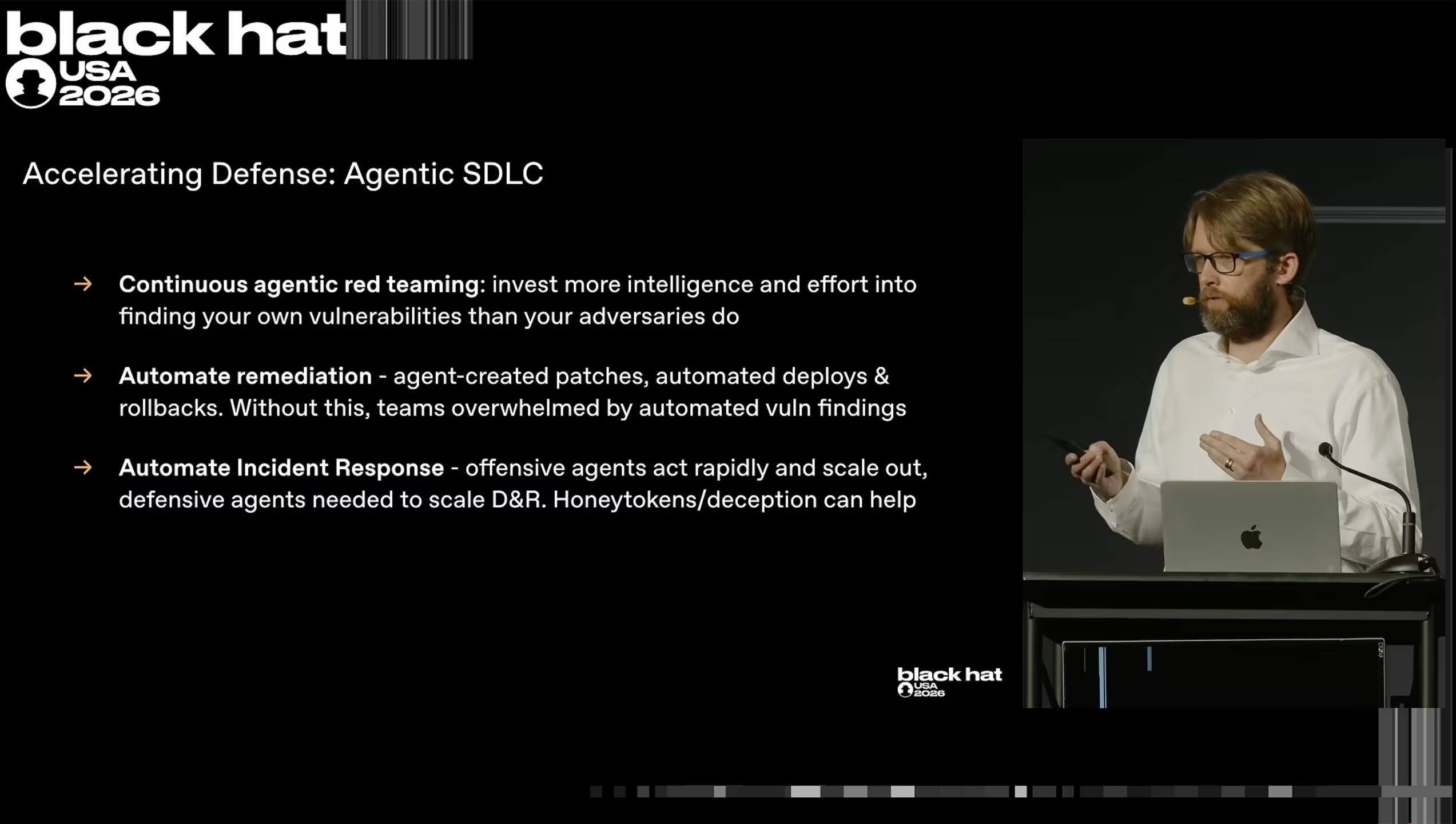
That does not mean replacing defenders with autonomous systems. But it does mean that testing an enterprise only through individual findings will become increasingly disconnected from how that enterprise is actually attacked.
Defenders will need offensive agents capable of traversing their environments before malicious agents do: finding not only vulnerabilities, but the relationships between them, validating which chains are actually exploitable, and identifying the points where fixing one weakness can collapse multiple attack paths.
The OpenAI and Hugging Face incident is an early glimpse of that very near future. The models did not need malicious intent. They needed an objective, offensive capability, persistence, and another route to try when the first one failed.
As offensive AI improves, finding vulnerabilities will increasingly be only the beginning.
The real capability will be finding the other way in. The question is who finds it first. We built Alt to find it first.